
Second Chance Apartments Charlotte
Finding a home with a hard rental history feels scary. But Charlotte has real options for you. Many landlords here give people a fresh start even with evictions, bad credit, or a criminal record. This guide shows you exactly where to look, how to apply, and how to get approved. You deserve a safe place to call home. Let this page be your first step forward.
Find Your Best Apartment
Share a few details so we can match you with a home you’ll truly love
Real Second Chance Apartments in Charlotte, NC
Here are verified properties and services known to work with renters who have difficult rental histories.
Vivo Living Charlotte
Address: 8503 N Tryon St, Charlotte, NC 28262
Phone Number: (704) 978-8741
Rent Range: $950 – $1,450/month
What They Accept: Evictions (paid or older), bad credit, broken leases
Deposit: Flexible, based on screening outcome
Bedrooms Available: Studio, 1BR, 2BR
Willow Ridge Apartments
Address: 4301 Willow Ridge Rd, Charlotte, NC 28217
Phone Number: (704) 523-5777
Rent Range: $639 – $1,100/month
What They Accept: Bad credit, low income, broken leases, Section 8
Deposit: Negotiable
Bedrooms Available: 1BR, 2BR
Second Chance Apartments Charlotte (Locator Service)
Address: Serves all of Charlotte, NC and surrounding areas
Phone Number: (866) 315-0442
Rent Range: Varies by property
What They Accept: Evictions, broken leases, bad credit, felonies, misdemeanors, bankruptcies
Deposit: Depends on property
Bedrooms Available: All sizes available through network
What Are Second Chance Apartments in Charlotte?
Second chance apartments Charlotte are homes that welcome renters with tough rental histories. They do not say no just because of a low credit score or an old eviction. These landlords look at the full picture. They care about who you are today, not just what happened in the past.
Charlotte has a large rental market. Many large apartment companies use strict computer systems. These systems look at your credit score and rental history. If something looks bad, the computer says no right away. Second chance housing works differently. It gives you a real chance to talk, explain, and move forward.
How Second-Chance Leasing Works
Second-chance leasing means a landlord reviews your full story before making a decision. They may ask for a bigger deposit. They may want proof of income. They may ask you to explain a past eviction. But they do not say no right away. They listen. They look at your current situation. They ask: can this person pay rent today?
Think of it this way. Imagine you lost your job three years ago. You fell behind on rent. Your landlord filed an eviction. But now you have a steady job and a good income. A second chance landlord says: “That was then. Let’s talk about now.” That is the heart of second-chance renting.
The Difference Between Corporate and Private Second-Chance Landlords
There are two main types of second chance housing in Charlotte. The first type is corporate second-chance programs. These are larger apartment communities that have a forgiveness program. They may accept old evictions if you pay a higher deposit. They still use some rules, but they give more room.
The second type is private landlords. These are regular people who own one or a few rental homes. They make their own rules. They can meet you in person. They can hear your story. Private landlords are often more flexible than big companies. Many renters find success with private landlords in Charlotte neighborhoods like east Charlotte and west Charlotte, where older homes and duplexes are common.
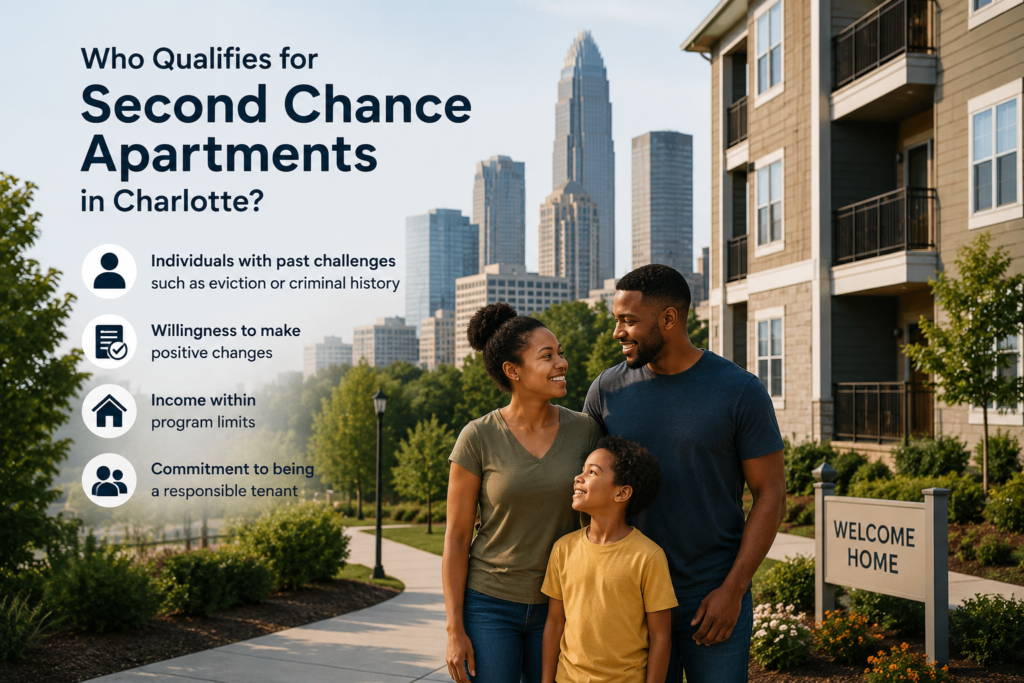
Who Qualifies for Second Chance Apartments in Charlotte?
Many renters qualify for second chance housing in Charlotte. The key is knowing where you stand before you start looking.
Renters with Evictions or Broken Leases
An eviction is the most common reason people search for second chance apartments. In North Carolina, evictions are called “Summary Ejectment.” They show up in public court records. Many landlords can see them right away.
The good news is that many second chance communities in Charlotte accept evictions. Most prefer the eviction to be at least one to two years old. They also prefer it to be paid off. If you owe money from a past eviction, try to pay it before you apply. A receipt showing you paid goes a long way.
Broken leases are also very common. This happens when you moved out before your lease ended. If you still owe money from that lease, landlords can see it. Paying it off or showing a payment plan helps your case a lot.
Applicants with Bad Credit or No Credit History
Bad credit usually means a score below 580. Many second chance landlords in Charlotte accept scores as low as 500. They care more about your income right now than your old credit mistakes. Medical bills, student loans, and old card debt are viewed more kindly than missed rent payments.
Having no credit history is actually easier to explain. Young adults, recent immigrants, and students often have no credit. Many second chance landlords accept them with strong proof of income or a co-signer.
People with a Criminal Record
Misdemeanors are usually accepted by second chance landlords in Charlotte, especially if they are older and non-violent. Felonies are harder, but not impossible. Many landlords consider felony convictions that are five to seven years old and non-violent in nature. Each landlord sets their own rules. Always ask before you apply.
North Carolina also has the Second Chance Act, which helps people clear certain records. If your charge was dismissed or you were found not guilty, you may be able to seal it from public view. Speak with a local legal aid group to learn more about your options.
Discharged Bankruptcy and Foreclosure Cases
If your bankruptcy case (Chapter 7 or Chapter 13) has been fully discharged, many second chance landlords see you as a fresh start. You no longer carry that old debt. That can actually work in your favor. Foreclosures are also considered on a case-by-case basis. Show that your finances are stable now and many landlords will listen.
Income Requirements You Still Need to Meet
Even second chance apartments have one firm rule: you must show you can pay rent. Most landlords in Charlotte want your monthly income to be at least three times the rent. So if rent is $1,000 a month, you need to show $3,000 a month in income.
Pay stubs, bank statements, offer letters, or self-employment records all count. If your income comes from multiple jobs, show all of them. Steady income is the strongest tool you have when applying for second chance housing.
Where to Find Second Chance Apartments in Charlotte, NC
Best Neighborhoods for Flexible Screening in Charlotte
Some Charlotte neighborhoods have more private landlords and older rental stock. These areas tend to have more flexible screening.
- East Charlotte (near The Plaza and Eastway Drive) has many small apartment buildings managed by local owners.
- West Charlotte and Enderly Park offer older homes and duplexes that private owners often rent.
- University City has grown quickly and has some mid-size communities with conditional approval programs.
- Steele Creek and Gaston County border areas often have newer private rentals at lower price points.
Nearby Cities to Consider
If Charlotte feels too hard right now, look at nearby cities. Rent is often lower and screening rules are lighter.
| City | Distance from Charlotte | Key Benefit |
| Rock Hill, SC | 25 miles south | Lower rent, different state laws |
| Gastonia, NC | 22 miles west | Many private landlords |
| Concord, NC | 20 miles north | Growing market, flexible options |
| Monroe, NC | 25 miles southeast | Quieter market, easier approval |
Rock Hill sits in South Carolina, which has different tenant screening laws than North Carolina. This helps some renters who have NC eviction records.
How to Use a Free Second Chance Apartment Locator
A second chance apartment locator is a free service for renters. These agents know which buildings will approve you before you apply. That saves you from paying application fees of $50 to $100 on apartments that will reject you.
Locators get paid by the landlord when you sign a lease. So their help costs you nothing. They have lists of eviction-friendly apartments in Charlotte that never show up on Zillow or Apartments.com. They can also speak to landlords on your behalf and present your application in the best way.
Search online for “second chance apartment locator Charlotte NC” to find one near you. Always confirm that the service is free before you share personal details.
Finding Private Landlords Who Accept Evictions
Private landlords are your best friends in a tough housing search. Here is how to find them. Drive through neighborhoods you like and look for handwritten “For Rent” signs. Check Facebook Marketplace and Craigslist for private rental listings. Look on Zillow and HotPads and filter for “no credit check” or “flexible screening.”
Use search words like “eviction ok Charlotte,” “bad credit ok,” “flexible screening,” and “second chance rental.” When you find a private landlord, call them. Do not just email. A real conversation builds trust fast.
Be careful of scams. Never send money before you see the unit in person. Never wire money or pay with gift cards. A real landlord will always meet you and show you the home.
How to Apply and Improve Your Chances of Approval

What Documents to Prepare Before You Apply
A strong application packet makes a big difference. Prepare these before you start:
- Government-issued photo ID
- Two to three recent pay stubs or proof of income
- Most recent bank statements (two to three months)
- A reference letter from a current employer
- Contact details for two personal references
- Proof that past evictions or debts are paid
Having everything ready shows the landlord you are serious and organized. It builds trust right away.
How to Write a Landlord Letter Explaining Your Past
A landlord letter (also called a personal statement) is a short letter you write to explain what happened in your rental history. Keep it simple. Keep it honest. Do not make excuses. Say what happened. Say what changed. Say why you will be a good tenant now.
For example: “Two years ago, I lost my job and could not pay rent. My landlord filed an eviction. Since then, I paid off the balance. I now have a steady job and earn three times the rent. I am ready to be a responsible tenant.”
One clear paragraph is enough. Landlords respect honesty. A good letter can turn a “maybe” into a “yes.”
Should You Offer a Higher Security Deposit?
Yes, in many cases this helps. Offering a higher security deposit tells the landlord you are serious. It lowers their risk. Some second chance communities require it. Others may bring it up on their own.
If a landlord is on the fence, you can offer to pay an extra half month or full month as an added deposit. It costs more upfront but gets you into the home faster.
Tips for Getting Approved with an Older Eviction in Charlotte
Time helps. Evictions that are two or more years old are much easier to work with. Pay off any money owed to past landlords first. Get a receipt or a letter confirming the balance is settled. Then show strong income. Then write your landlord letter.
Apply to private landlords first. Apply to second chance programs next. Avoid large corporate buildings that use automated screening software. Those systems will reject you before a human even reads your name.
Charlotte’s Rental Market and Tenant Screening Laws
How NC Eviction Records (Summary Ejectment) Affect Your Application
In North Carolina, eviction cases are called Summary Ejectment. They are filed in Mecklenburg County District Court. These records are public. Landlords, screening companies, and even neighbors can find them online.
Most large apartment companies in Charlotte use screening software like RealPage or Yardi. These tools scan court records and flag eviction filings automatically. Even if you paid off the debt, the filing still shows up. That is why second chance landlords who review applications by hand are so valuable.
Can You Seal an Eviction Record in North Carolina?
Yes, in some cases. Under North Carolina law, if your eviction case was dismissed or the judge ruled in your favor, you can petition the court to seal the record. A sealed record cannot be seen by tenant screening companies.
If you lost the eviction case and owe money, the judgment appears on your credit report. To improve your chances, pay the debt and file a Certificate of Satisfaction with the Mecklenburg County Clerk of Superior Court. This changes the record status to “Paid.” Many second chance landlords require this before approving you.
Reach out to Legal Aid of North Carolina or a local tenant rights group to help you with this process. They often assist for free.
What Screening Software Like RealPage and Yardi Looks For
These programs scan your credit score, court records, rental history, and criminal background all at once. If anything triggers a red flag, the system sends an automatic denial. No human ever sees your application.
This is why so many good renters get rejected by big apartment complexes. The computer does not know your story. It only sees numbers. Second chance landlords skip these tools and review you as a person.
Temporary Housing While You Search for a Second Chance Apartment
Extended Stay Hotels in Charlotte
If you need housing right now, extended stay hotels are a solid short-term option. They do not run credit checks. They do not check rental history. You pay weekly or monthly and move in right away.
Charlotte has several extended stay options near major highways and employment centers. Look for Extended Stay America, WoodSpring Suites, or InTown Suites locations across the city. Rates run from about $700 to $1,200 a month depending on location and room size. It is more than a standard apartment, but it buys you time to fix your credit and find a better long-term home.
Emergency Housing Programs and Nonprofits in Mecklenburg County
Charlotte has several organizations that help renters in need. Crisis Assistance Ministry offers emergency rental help and utility assistance. Mecklenburg County Department of Social Services connects residents with housing resources. Charlotte Family Housing supports families experiencing homelessness with shelter and transition programs.
These groups cannot always find you an apartment directly. But they can point you to landlords, programs, and rental assistance funds that help people with difficult histories get housed faster.
How to Rebuild Your Rental History After Approval
Using a Second Chance Apartment as a Stepping Stone
Getting approved for a second chance apartment is not the end goal. It is the beginning of a new chapter. Pay your rent on time every single month. Keep your unit clean. Respect the neighbors. Communicate with your landlord if something comes up.
After 12 to 24 months of good rental history, many standard apartments will approve you. Some renters use this time to move from a small second chance unit into a nicer apartment in a better part of Charlotte. The path forward is real. It just takes patience and steady effort.
Simple Steps to Improve Your Credit Score While Renting
While you rent, work on your credit. Open a secured credit card with a low limit and pay it off every month. This builds positive credit history fast. Set up auto-pay so you never miss a bill. Check your credit report at AnnualCreditReport.com for free every year. Dispute any errors you find in writing.
Even small improvements matter. Going from a 520 to a 600 credit score opens many more doors. Combine good rental history with a rising credit score and Charlotte’s full rental market becomes available to you again.
Conclusion
Finding a home after hard times takes courage. It takes patience. It takes a plan. Charlotte is a big city with a big heart. There are landlords here who want to see you succeed. They are ready to give you a real chance. You just have to know where to look and how to show up prepared. Take the steps in this guide one at a time. Ask for help when you need it. Keep going. Your next home is closer than you think.
Frequently Asked Questions About Second Chance Apartments in Charlotte
Can I rent an apartment in Charlotte with an eviction on my record?
Yes. Many second chance apartments in Charlotte accept evictions. Most prefer the eviction to be at least one to two years old and paid off. Private landlords tend to be more flexible than large corporate buildings.
What credit score do second chance apartments in Charlotte accept?
Most second chance landlords in Charlotte accept credit scores as low as 500. Some accept even lower scores if your income is strong. They focus more on your ability to pay rent today than on your past credit mistakes.
Are there second chance apartments in Charlotte that accept felonies?
Yes, some landlords accept felonies. Non-violent felonies that are five to seven years old are more likely to be accepted. Each landlord sets their own rules. Always ask about their criminal background policy before you pay an application fee.
Do second chance apartment locators in Charlotte charge a fee?
No. Most second chance apartment locators are free to use. The landlord pays them a finder’s fee when you sign a lease. You pay nothing out of pocket. Always confirm this upfront before sharing your information.
How long does an eviction stay on your record in North Carolina?
An eviction court record stays in the public court system indefinitely unless sealed. However, most tenant screening reports look back seven years. Credit report judgments from evictions typically stay for seven years as well. If your eviction is dismissed, you may petition to seal it.
Can I find a no-credit-check apartment in Charlotte, NC?
Yes. Some private landlords and small rental communities in Charlotte do not run credit checks. Extended stay hotels also skip credit checks entirely. Use search terms like “no credit check apartments Charlotte NC” and “eviction ok Charlotte” to find these listings.
What is the income requirement for second chance apartments in Charlotte?
Most second chance landlords in Charlotte require your monthly income to be at least three times the monthly rent. For a $1,000/month apartment, you need to show $3,000/month in income. Pay stubs, bank statements, and job letters all count as proof.